 Mainframe Tutorial
 JCL Tutorial
 Introduction
 Mainframe Interview Q&A
 Mainframe Quiz
 Mainframe Memes
 Contact us
 About us
Module 14: CICS Performance, Security and Advanced Topics
 Backward

Multiregion Operation (MRO)
Multiregion Operation lets several CICS regions on the same z/OS system work together as one system. Users see one CICS, but the work is spread across regions.
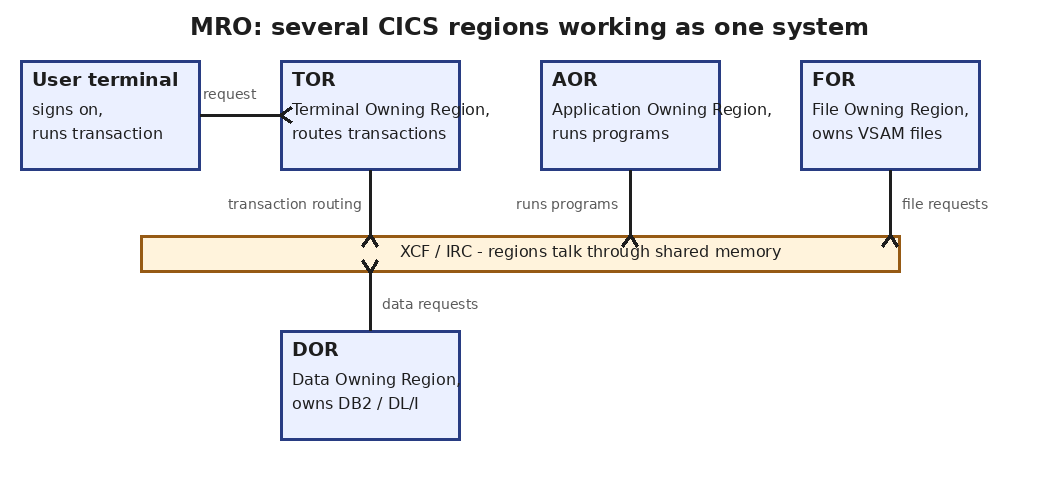
The diagram above shows the classic MRO layout: the terminal owning region takes user requests and routes the work to application, file, and data owning regions through XCF/IRC.
Why use MRO
- Split work by type: one region handles terminals, another runs applications, another owns files.
- If one region fails, the others keep running. Restart only the failed region.
- Add more application regions when load grows, without touching terminal definitions.
- Regions talk to each other through XCF (cross-system coupling facility) or IRC (interregion communication).
Region roles
- TOR - Terminal Owning Region: owns the terminals and routes transactions to the right region.
- AOR - Application Owning Region: runs the application programs. You can have many AORs.
- FOR - File Owning Region: owns the files. Application regions ship file requests to the FOR.
- DOR - Data Owning Region: owns data resources like DB2 or DL/I in some designs.
Defining an MRO connection
- Each pair of regions is connected with a CONNECTION definition using ACCESSMETHOD(XM).
- SESSIONS definitions set how many parallel conversations the regions can have.
- Use CEMT SET CONNECTION(name) ACQUIRED to start the connection, and INSERVICE to make it usable.
- CEDA DEFINE CONNECTION(AOR1) GROUP(MROCONN) ACCESSMETHOD(XM) SINGLESESS(NO) CEDA DEFINE SESSIONS(AOR1S) GROUP(MROCONN) CONNECTION(AOR1) MAXIMUM(50,10)
- The connection name must match the APPLID of the other region.