Module 5: CICS BMS and Screens
What is BMS?
What is BMS
- BMS stands for Basic Mapping Support.
- It is an IBM-supplied facility of CICS that handles 3270 terminal screens for application programs.
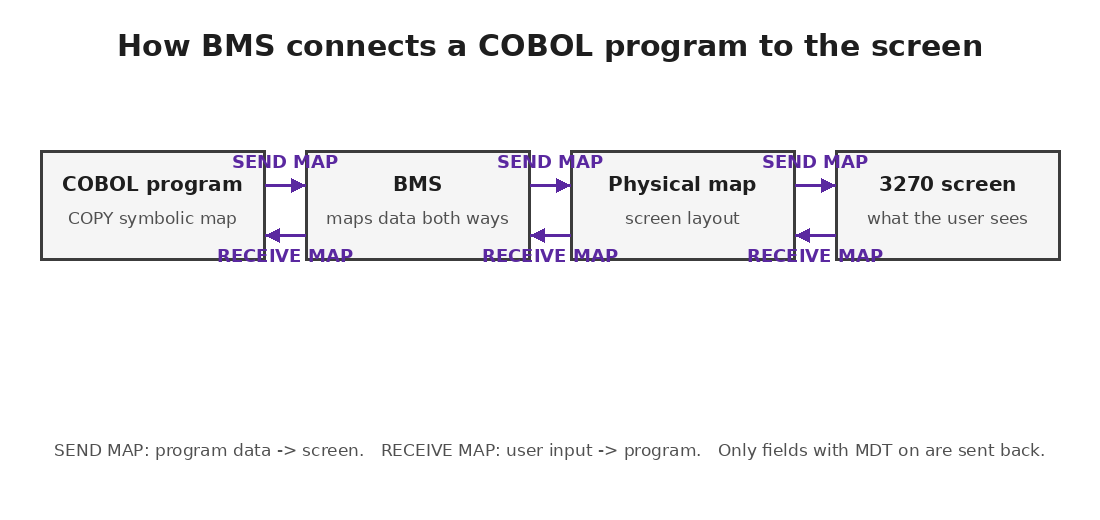
- With BMS, a program sends and receives screen data using simple field names, not screen positions or device control characters.
- BMS converts the program's data into the 3270 data stream the terminal understands, and converts the terminal's input back into program data.
Why BMS is used
- The screen layout is kept separate from the program logic.
- The program does not need to know device-dependent details like screen size or control characters.
- The same program can work with different 3270 terminal models.
- A screen can be redesigned without changing the program - only the mapset is reassembled.
How BMS works
- The programmer designs the screen and codes it with BMS macros (DFHMSD, DFHMDI, DFHMDF) to form a mapset.
- The mapset is assembled to produce a physical map (the screen layout) and a symbolic map (a COBOL copybook).
- The COBOL program includes the symbolic map with a COPY statement, then uses SEND MAP and RECEIVE MAP commands.
- At run time, BMS merges the program's data with the physical map and displays it on the screen.
MainframeBug Assistant

 Mainframe Tutorial
 JCL Tutorial
 Introduction
 Mainframe Interview Q&A
 Mainframe Quiz
 Mainframe Memes
 Contact us
 About us
 Backward
