
 Mainframe Tutorial
 JCL Tutorial
 Introduction
 Mainframe Interview Q&A
 Mainframe Quiz
 Mainframe Memes
 Contact us
 About us
Module 8: DB2 Indexes and Constraints
 Backward

What is an Index?
An index is one of the most important performance objects in DB2. The diagram below shows how an index points to table rows:-
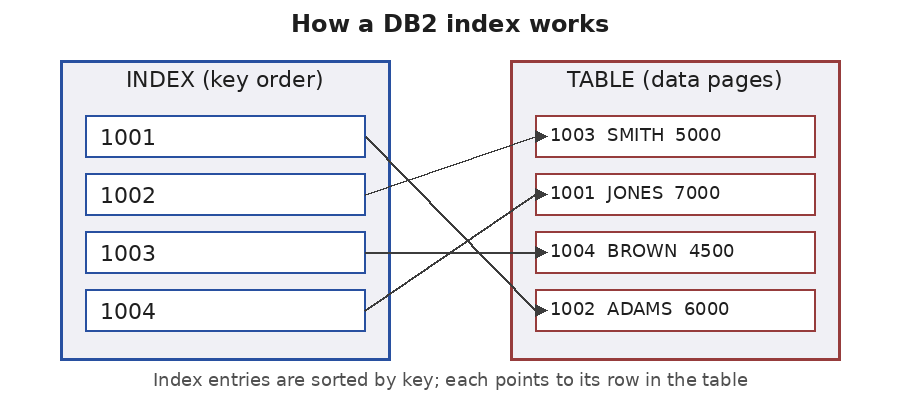
Explanation for the above diagram is as follows:-
What is an index?
- An index is a set of pointers which can refer to rows in a table.
- It is created on one or more columns of a DB2 table to speed up data access for queries.
- The index entries are ordered based on the value of the key columns, so DB2 can jump straight to the wanted rows instead of scanning the whole table.
- An index is stored in an index space. DB2 automatically creates the index space when you run CREATE INDEX.
- An index can also improve performance of operations on views and help cluster or partition the data efficiently.
Why use an index?
- Faster data retrieval - DB2 finds rows through the index instead of reading every page of the table.
- A table with a unique index can have rows with unique keys, which protects data integrity.
- Indexes support efficient ordering and grouping for ORDER BY and GROUP BY queries.
- But too many indexes slow down INSERT, UPDATE and DELETE, because DB2 must update every index on the table.
Example
- Example:-
CREATE INDEX IX_EMPNO ON EMP (EMPNO);
- Above statement creates an index named IX_EMPNO on the EMPNO column of the EMP table.
- Drop an index you no longer need:-
DROP INDEX IX_EMPNO;